 Joe Hannon's blog
11: Connecting ray limit to the underlying reactions
The change in molar amount of a species as a result of one or more underlying reactions is calculated classically from the extents of the underlying reactions occuring and the stoichiometric coefficients on the species in those underlying reactions:
\[n_{i}-n_{i0}=\sum_{j}e_{j}\nu_{ij}\]In the case of the 5-reaction system we are using for illustration, the full scheme is: A+B>R, A+R>S, A+B>T, A+T>S, A+C>Q and denoting the extents as $\alpha$, $\beta$, $\gamma$, $\delta$ and $\epsilon$ respectively, a one-line compsote reaction extent summary based on the extents of the underlying reactions is:
\[(\alpha+\beta+\gamma+\delta+\epsilon) A + (\alpha+\gamma) B + \epsilon C > (\alpha-\beta) R + (\gamma-\delta) T + (\beta+\delta) S + \epsilon Q\]from which:
\[f_{s}=\frac{(\alpha+\beta+\gamma+\delta+\epsilon)\min(C_{B0}/(\alpha+\gamma), C_{C0}/\epsilon)}{C_{A0}+(\alpha+\beta+\gamma+\delta+\epsilon)\min(C_{B0}/(\alpha+\gamma), C_{C0}/\epsilon)}\]With $\alpha=1$, $\gamma=0$, $\delta=0$ and $\epsilon=1$ this becomes substantially equivalent to Equation (41) in the 2025 paper. I used the above extended closed form equation to calculate fs by hand for a range of values of $\alpha$, $\beta$, $\gamma$, $\delta$ and $\epsilon$ and tabulate below relevant results for the current illustration full-size:
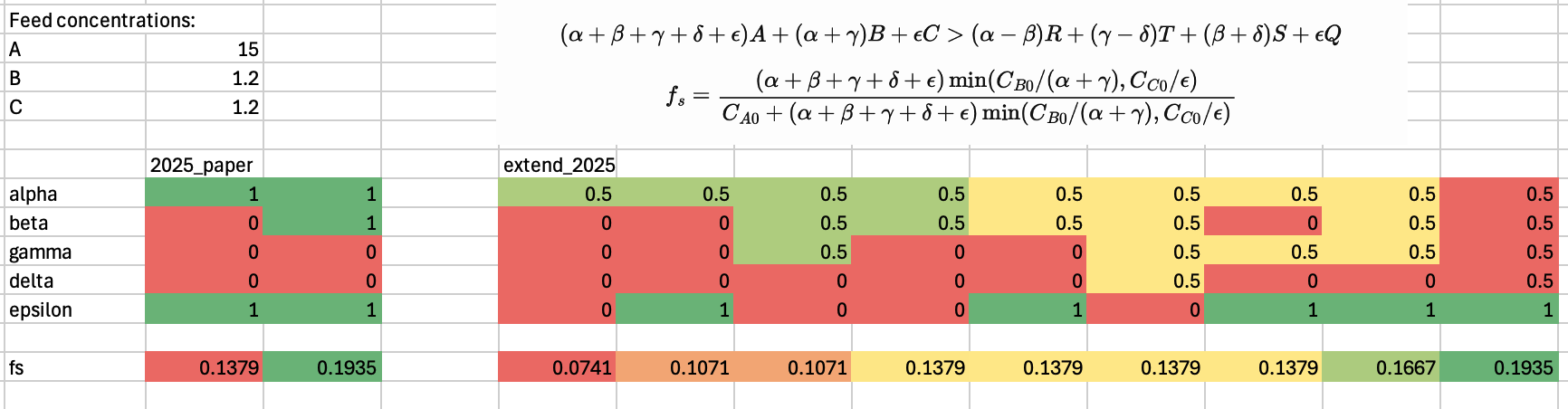
Colour coded formatting shows green for large values and red for small. It is clear that the broader fs formula above leads to a wider range of possible fs values than those shown in the 2025 paper.
A subtle point that is easy to miss (I missed it at first) when generating results manually with the extents of the 5-reaction system, is that when all of the reactions proceed, the true extents (Greek letters) cannot be equal for them all at fs; that is because there is now outright and equal direct competition along two pathways for each of A and B when forming R and T before they proceed to S. At the limit when all reactions are infinitely fast, the extent of the fifth reaction must be twice the extent of each of the others in order for the amount of C to reach zero. That is exactly how the ODE solution behaves.
You can think of this single line composite reaction summary as a report on what has happened in the underlying reactions up to the current time. Infinitely fast reaction limits can be obtained from the single summary reaction and used to bound the estimates we need of C(f) with the no-reaction limit / mixing line bounding C(f) on the other side.
The method to obtain the infinitely fast limit is to find the point, $f_{s}$ at which reactants from each stream cannot coexist. ray_limit does this by pushing its ray to the maximum possible extent.
This breadth of approach is not described in the 2025 paper or the prior 2009 paper or anywhere else that I have seen. Nevertheless, it appears to be quite generally applicable, as any reaction system may be summarily written in this single-line form, replacing stoichiometric coefficients with overall reaction extents for each species.